Feeling the Heat
4 years, 1 month, 14 days, 18 hours

7 June 2025
Healthcare systems are going to need a revolution to cope with rising climate temperatures.
Almost exactly a year ago I wrote about climate change being the biggest health threat facing humanity. More evidence for that has come over the last two months in India and Pakistan where temperatures up to eight degrees higher than normal, reaching 48 degrees in one part of Pakistan, have triggered a big jump in heat-related illnesses. And a study published just a few weeks ago by the Delhi-based Council on Energy, Environment and Water concluded that 76% of the population of India is now at high or very high risk of heat illness or death from exposure to extreme temperatures. Copied below is a map of the distribution of that risk.
It was against that backdrop that the 78th World Health Assembly met from 19 – 27 May in Geneva. The World Health Assembly is the highest decision-making body of the World Health Organisation, with 194 Member States represented. And not-surprisingly, but happily, the relationship between climate change and health was top of their agenda and resulted in the adoption of the Draft Global Action Plan on Climate Change and Health, whose more than 100 proposed actions (too many, methinks) includes a call to integrate health into Nationally Determined Contributions and national-level climate plans and strategies.
Neatly timed to coincide with that discussion, the European Investment Bank published on 21 May what it claims is the first tool to directly quantify the link between climate change and healthcare. The short report introducing that tool can be accessed here: Estimating the impact of climate change on European healthcare. The tool calculates how specific challenges – such as heatwaves or floods – increase the need for healthcare services, and forecasts an annual increase in healthcare demand due to climate change of 0.5%. Which doesn’t sound like much but that is year after year, onto healthcare systems which are already under extreme strain everywhere.
Rising climate temperatures won’t be reversed anytime soon, sadly. And life confined to air-conditioned rooms isn’t much fun, if you are lucky enough to have air-conditioned rooms to retreat into. So healthcare systems are going to need a revolution to cope. That means drawing in a lot more private money (another theme of the gathering in Geneva) and digital transformation, a theme picked up in KPMG’s just-released Intelligent Healthcare report.
Figure ES3: More than 57% of districts are at high to very high heat risk in India.
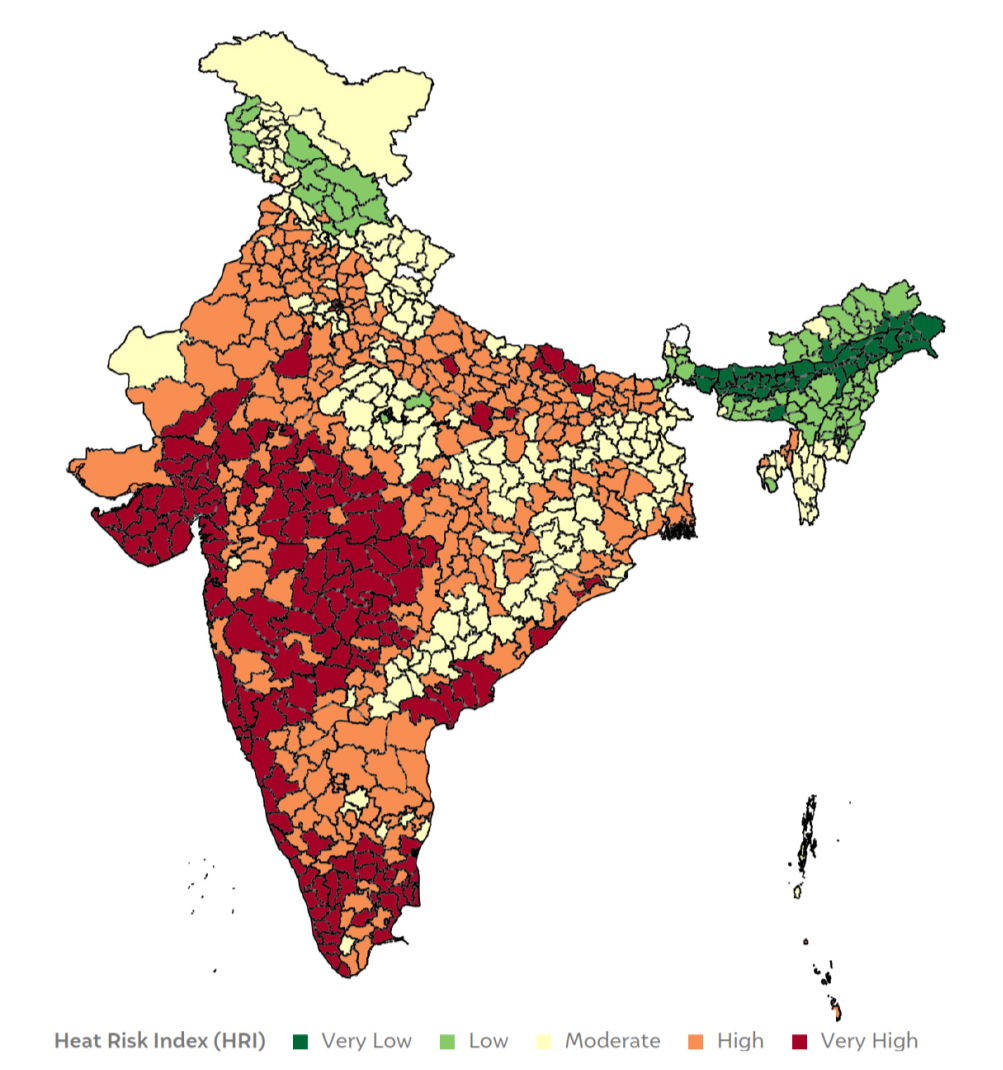
Image credit: Council on Energy, Environment and Water (India)